Friday, August 10, 2012

Guatapé

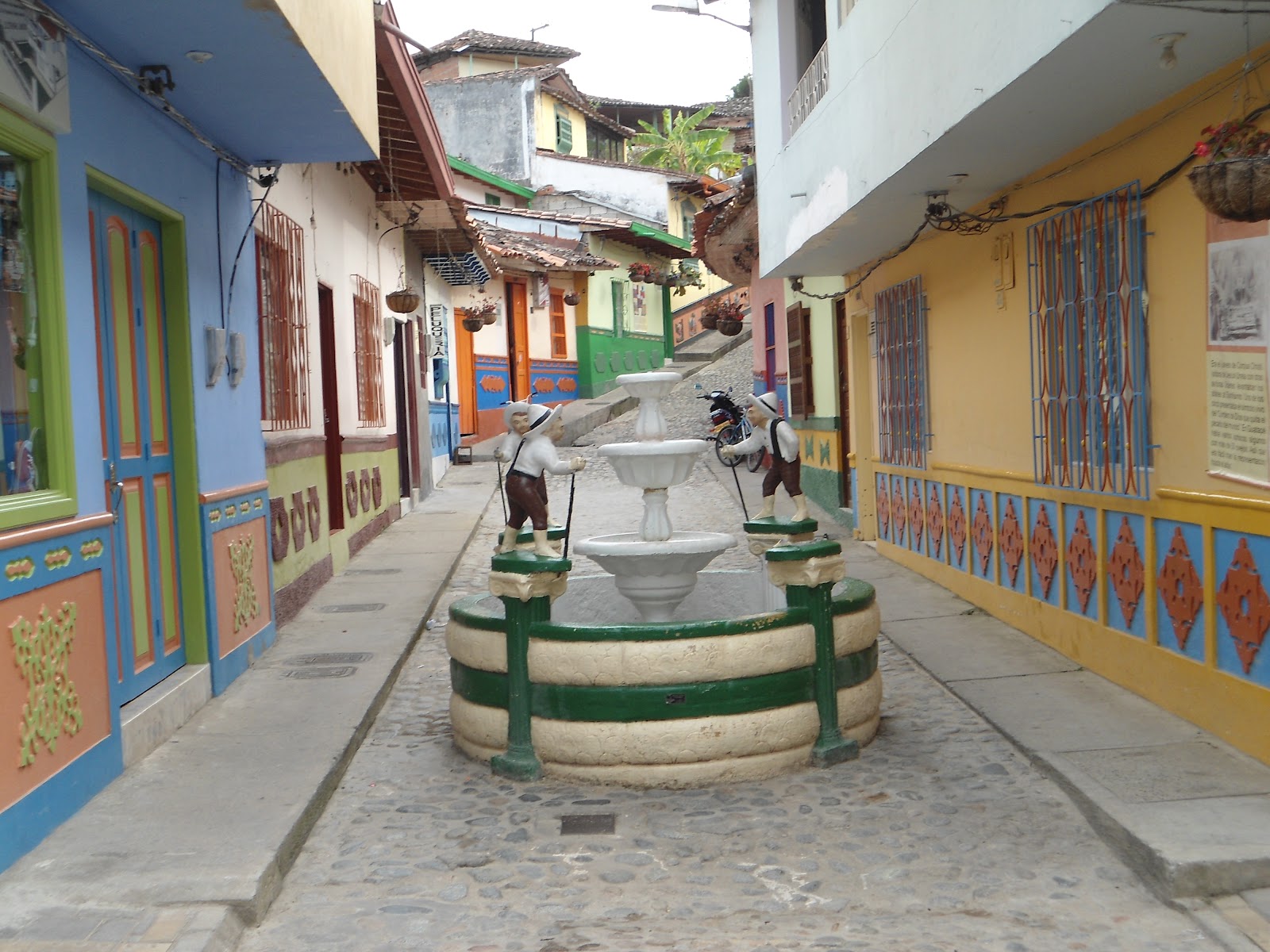
2 hours outside of Medellin is a quaint town called Guatape. This place a is a big tourist attraction because of the colorful houses, the surrounding lakes, and this huge rock so randomly placed (has many theories about how it got there, from a volcano to a meteorite).


Tourists can climb the 649 stairs to the top of Peñón de Guatapé (a rock about 200 meters high). From the top there is a beautiful view of the surrounding lakes.

From the top of the rock

Lunch; Bandeja Paisa; fried trout, fried eggs, plantain, salad, beans
PHOTOS FROM THE TOWN:


Wednesday, August 8, 2012

La Feria de los Flores

The biggest day of the week long festival is the desfile de los silleteros (parade of farmers and rural villagers from Santa Elena who come down from the mountains carrying flowers on their back throughout the parade). These campesinos carry a "Silleta", which is a traditional wooden structure used for transportation and has a big part of Paisa (people who inhabited northwest Colombia) history. On this wooden frame, they unleash there creativity and decorate it with flowers of different designs and colors, which are cultivated in Santa Elena. 


The history behind the "Silleteros", started when the farmers of Santa Elena, realized that these wooden frames could be used to transport and sell their flowers in the city of Medellin.


The parade was really unique & I am glad I got to be part of such a huge day in Medellin. By the end of it, I didn't really want to see another flower. As you can imagine (for the biggest event of the year for a city), it was sooo busy. A few people that I went with from the hostel had their stuff (cameras, wallets) pick-pocketed instantly. I wasn't able to take good photos either (some of these photos are stolen from Google images.)


The crowds and the pick-pocketers weren't the only downfall for us. We stood near the end of the parade since we arrived late. The participants in the parade were super tired. There were actually a few people being carried out on stretchers. These campesinos are tough, but I can't imagine how hard it must be for them to carry something that sometimes weighs as much as them(all the way through the parade & then some).


After the parade, we were waiting in line to buy food, when a lovely Colombian family (husband, wife, and their 11 year old daughter), started talking to us. We all connected instantly, and all went out to a bar  (at a supermarket... yeah, weird, right?) Nonetheless, it is always nice being able to spend time with locals.

Tuesday, August 7, 2012

Medellin, Colombia


After waiting 3 hours at immigration in Ecuador just to get my exit stamp, I finally walked over that bridge and into Colombia. It's always fun entering a new country and getting a new stamp on the passport. Fortunately, I met some other gringos in line to help kill the time and eliminate some stress that goes along with crossing the border. After having some confusions of what day it was (it is quite hard keeping track of days while traveling), I changed my mind and decided to take a directo bus from the border town of Ipiales to get to Medellin for the weekend and the start of La Feria de los Flores ("Flower Festival" - the most important social event for the city which is every year.) It is a week long festival full of events, concerts, parades, and exhibitions.  


Santuario de Las Lajas


I had about 7 hours to kill in between buses. The border town of Ipiales, Colombia is a great place to kill that amount of time. 15 minutes outside of the city is a beautiful church (Santuario de Las Lajas) built inside a canyon.


a view point of the church


My bus left at 7pm that night, and didn't stop for food until almost 1pm the following day.  We stopped at some restaurant, where I finally had a chance to get some food (after going more then 21 hours of not eating), I ordered Bandeja Paisa, which is a traditional dish consisting of chicken, fried plantains, fried eggs, refried beans, and avocado. While on the subject of food, I would like to mention their love of cheese here in Colombia. Fruit and cheese. Chocolate with cheese. Ice cream with cheese. I did fall in love with the Obleas, which are waffers with arequipe (similar to dulce to leche or caramel), and of course, cheese.


After a long ride, I finally got to Medellin, where I met up with Duffy and Lewis (two guys that I did Peace Corps with) at the Palm Tree Hostel. This hostel I would highly recommend. Here you will get the friendly, warm intimate feeling where you will likely befriend & spend your time hanging out with everyone in the hostel.  The great staff and warm enviroment make up for the not so comfortable beds (only downfall).  

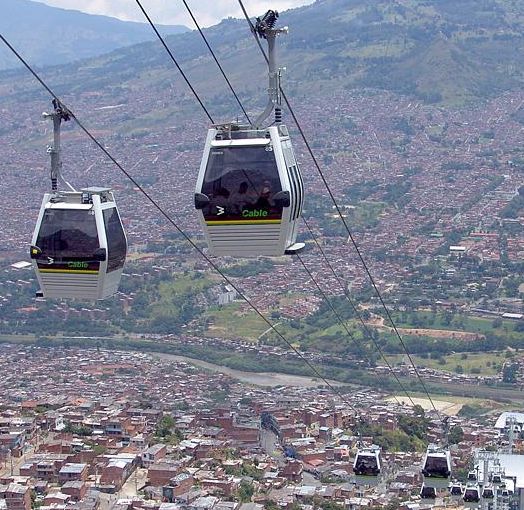
My first night we went to a concert, the Gypsy Kings, a band from Spain who sing Bamboleo, Bamboleo. The following day I went with some Danish girls up the cable cars (a transportation service developed to reach the suburban areas in Medellin) to Santa Elena.  Santa Elena are where all the flowers come from for the festival.
 
Below are some photos from the Flower Exhibition in the Botanical Gardens:


Wednesday, August 1, 2012

Final Days in Ecuador

The end to another country, and I will say it again .. Wow, Ecuador. Now, THAT was my favorite. Alright, I know I said it for Peru, and I likely said it for Bolivia. Each country that I have traveled in South America is completely different & it is hard to compare the beauty within each of these countries to each other. However, Ecuador did something different for me. It will forever have a special place in my heart. I feel I have gotten so much out of my travel experience from this small little country & the people that crossed my path within it.

some village kids showing off their new puppies
I can't really explain it.  Perhaps I reached a part of my traveling where the excitement of all these new sights have worn off. The stress has well worn off, and traveling is certainly much easier for me. Everything is normal for me, and now I'm just living my life within these countries. During the past month, I took time to really think about my time here in South America, about my life, about learning the cultures, meeting new people & gathering a deeper understanding of how the universe connects us all.

sombreros; Otavalo Market
 I have met incredible people along the way, from all over the world. Some that I've spent a day with, and some that I have spent weeks with. No matter how long, I truly believe I have met every one of them for a reason; from the locals to the other tourists. Traveling has given me a deeper understanding of myself, life, other people, and how the universe connects us all. These people have really shown me a lot & have opened my eyes up to more then I could imagine. I am very thankful for everyone that I have met & continue to meet on my journey.


ladies on the street trying to earn a living

My last stop in Ecuador was Otavalo (about 2 hours north of Quito). Otavalo is a beautiful place surrounded by 3 volcanoes. It is home to the largest market in Ecuador. The market is everyday in La Plaza de los Ponchos, but it is biggest on Saturday. Unfortunately, I didn't get to see the big market, which consists of an animal market in the morning. I did get to see the idea of these markets and how the people here make their living.  The plaza is full of people selling mainly textiles (of wool), jewelry, leather, food, spools of wool, and many of their own handmade crafts.

 
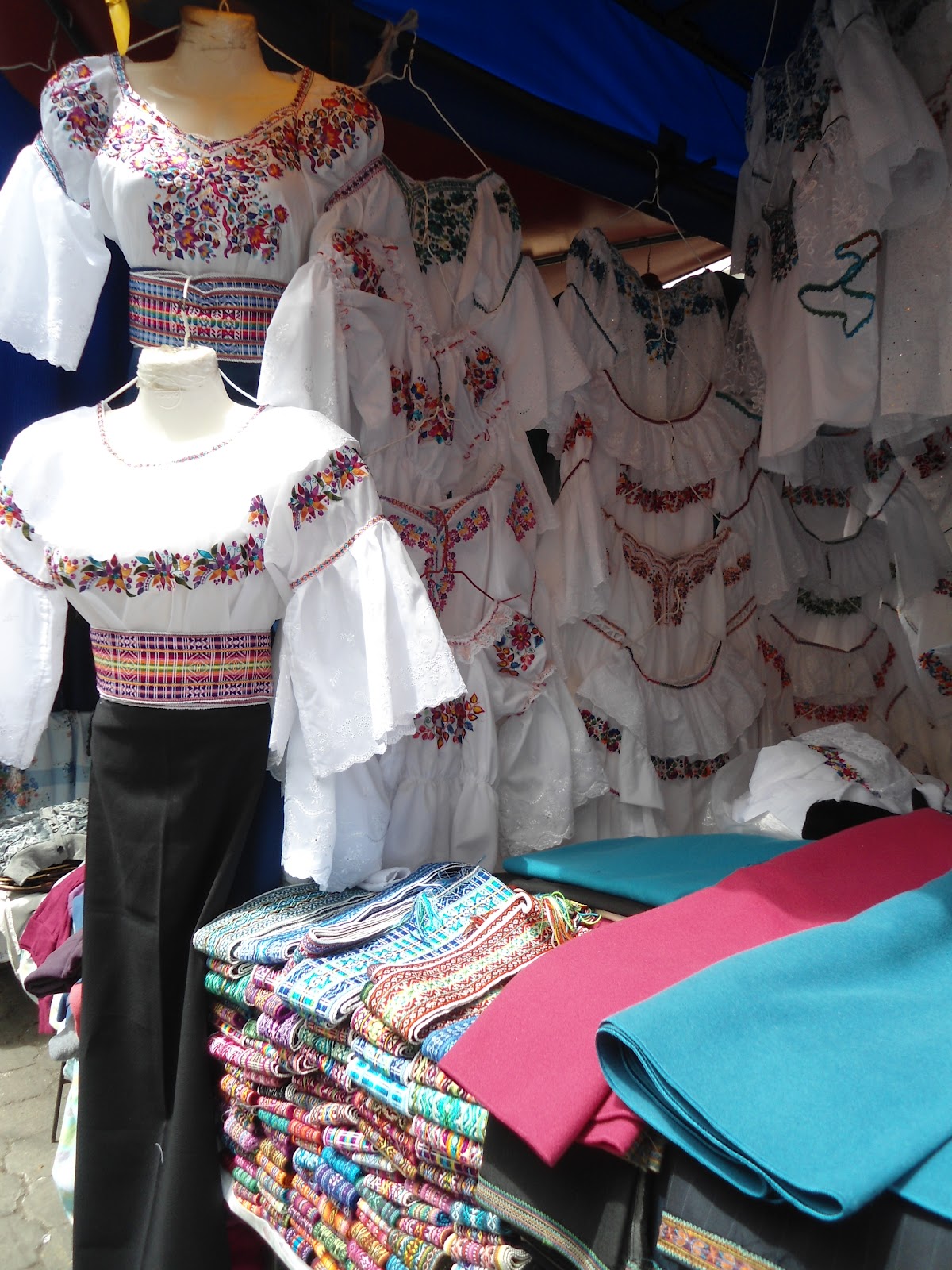
What is special about this place (to me) are the people, and their clothing. The Otavalolena women wear distinctive white embroidered blouses, with flared laced sleeves with black skirts. Their long hair is tied in the back with a 3 inch band of woven multi-colored material.  Men wear white trousers with dark blue ponchos. The clothing is much different then any of the other indigenous populations of people I have come across. It was as if I missed a parade or something.

example of clothing the Otavalan women wear
(since it is impossible and disrespectful to take pictures of them)
 Here i stayed at Hostal Chasqui, which I would highly recommend to anyone needing a break from other travelers and seeking alone time. I think this hostel came to me at the right moment, because I just wanted to spend these days relaxing. I was able to get a private room/bathroom for $10. Now I feel well rested to spend the next 3 days in a row on a bus.


Now, I move on to Colombia; the final country of my 5 month trip throughout South America.
  • Tentative schedule for Colombia:
    • August 5th - August 12th : Medellin (for La Feria de los Flores)
    • August 13th - August 23rd: Cartagena/Taganga/Santa Marta (the coast area)
    • August 24th - August 26th: San Gil
    • August 26th - Sept 1: Salento
    • Sept 2nd: Fly to El Salvador!
    • Sept 14th: FLY HOME!!


Wednesday, July 25, 2012

and the winner is.... Mother Earth

Volcano Cotopaxi... the highest active volcano in the world @ 5,897 meters (19,347 feet). After doing the Quilotoa Loop I felt a bit acclimated to the altitude here.  Martin, Ben, and I (3 out of the 5 people I did the Quilotoa Loop with) left Latacunga around 10 in the morning (after an hour long discussion in the agency as to if we should go or not, because we heard many people weren't able to summit because of the windy conditions). We are all fit people, and we thought, no problem, let's try it. We arrived at the parking lot in Cotopaxi National Park, and yeah no joke, the wind just about blew me away.  "Hopefully the wind will stop by the time we start walking at midnight", we all secretly wished.

Before the climb

During the skills section; practicing using cramp ons, and ice picks
 We arrived at the refugio (base camp @ 4800 meters (14,400 feet), where we will spend the night until we begin the hike at midnight).  In the afternoon, we walked about 30 minutes up the mountain to where the snow began, and practiced walking in cramp ons and using ice picks.
playing around with the ice picks
NOTE: you don't need to climb like this @ Cotopaxi
We ate dinner around 5:00, and tried to sleep shortly there after.  Sleep is nearly impossible there, as the hostel is noisy until about 8 or 9, and then people begin their climbs at 10:30 p.m.  We started the climb at 1:00 a.m.  Most tours do this in order to reach the summit by 8:00 a.m. and turn back around to base camp before the glacier starts to melt (making the conditions harder to walk in).


This trek was a struggle for me from the beginning. I didn't sleep a wink the night before (as I tried going to sleep at 8pm, knowing I had to wake up at midnight to start this trek). I was nervous/yet excited for the climb, so I started walking on no sleep. I could feel the effects right away.  Martin and Ben were paired with another guide, since they walked faster then me.  After about an hour into the hike, Ben decided it was smart to slow down, and joined Sergio (my guide) & I. Altitude is something you don't want to mess with.  Tied to a rope, with our cramp ons, ice picks, and hiking sticks, we (well mostly just me, and because we were all tied together, the other 2 were forced to do so too) took about 10 slow steps, then took a small break. 10 more steps, then another small break.


There were times, I would just collapse.  My strength wasn't good enough to handle walking up a mountain of ice & snow, with 30 mph winds.  Not having any sleep the night before certainly didn't help either. From the start, I was feeling the effects of the altitude (nausea & dizziness), but I kept motivating myself... "I"m getting to the top of that mountain!" Of course, I was freezing cold on top of that, but I figured the sun will eventually come up and warm our freezing cold bodies, so that won't be a problem.  


After about 4 and a half hours of walking, we arrived at 5,400 meters. Ben & I just collapsed down to take a break and catch our breath. We discussed if this suffering is even worth it.  The wind, the lack of sleep, the cold, and the feelings of altitude sickness. We only had about 500 meters to go (which would be another 2-3 hours). We just couldn't do it. We both admitted there were times where we could just cry it was so unbearable. We reached base camp, and our friend Martin was still out on the mountain. We assumed he reached the summit (as we later learned, he did). The 3 of us all agreed it was the most difficult thing (physically) that any of us has ever done (mainly because of the wind). Martin said, he couldn't even see a thing at the summit, not even the crater, because of the strong winds.
feeling defeated; walking back down the mountain

 It was still a wonderful experience for me. I have never challenged my body this hard before.  It is often rare that I "give up", as well. It was interesting to see just how much I could push myself, before throwing in the towel.  


Also, it shows, mother earth, wins. The power of mother earth is sometimes underestimated. She is stronger, bigger, and more powerful then any of us and we just can't compete.  It was not my time to be on the top of the world's most active volcano.  Cotopaxi, you will remain on my bucket list.

Saturday, July 21, 2012

Quilotoa Loop

The Quilotoa Loop is a 3 day loop through mountains & indigenous villages that ends at a volcano crater (if chose to begin it in Isinlivi like me). The lady in the hostel in Latacunga, Hostal/cafe Tiana recommended that I start in Isinlivi and end at the lake in Quilotoa to help with the acclimatization. I plan on hiking Volcano Cotapaxi here so I decided I better take her advice. [Cotopaxi is one of the highest active volcanoes in the world @ 19,400 feet (5,897 meters)].

 I am glad I did it this way, not only to help with the acclimatization, but because we ended the 3 day hike at a beautiful lake in a volcano crater. The struggle up the mountains makes the destination that much better.

fresh milk off the street of Latacunga
 This hike is is something I really didn't want to do by myself, as I heard many stories of people getting lost (guides are constantly taking down signs so that they get more business). At the hostel in Latacunga I lucked out and met an awesome girl from San Fran, Julie, who was looking to do the hike the following day.

Julie and I at an "Inca look out spot" in Isnilvi
We woke up early Wednesday morning to head to the market in Pujili with another guy from the hostel (Carlos, who went to high school in Danville. Small world.) We spent a few hours there before taking a bus back to Latacunga.  From Latacunga, we took the 12:15 bus to Isinlivi, which took 3 hours (a long, bumpy, windy road).  In Isinlivi, we stayed at Llullu Llama, which was great!

the hostel Llau Llama in Isnilvi
It was nice to spend an afternoon and night there, sharing stories around the fire, and resting for a big hike the next day.  At the hostel we met 3 guys (Ben from U.K., Martin from Germany, and Roger from Switzerland), and the 5 of us ended up doing the whole trek together.


After a great breakfast of homemade bread & jam, eggs, fruit salad and granola, we started our hike at 9:45 am. With a good map and track notes from the hostel, Roger took on the role of guide, and did a great job.  We only took the wrong path once which led us over a 2 log bridge and through a field of electric fences (I think everyone got shocked at least 4 times).


If we would have stayed on the path for another 20 minutes we would have crossed at a more pedestrian friendly bridge with handrails and no electric fences. Owell, just adds to the adventure I guess. 


The best part (besides the volcano crater) were seeing all the local villages and meeting some local people. We arrived at our destination of Chugchilian at 3:00.  Here we stayed at Cloud Forest for $12 a night (breakfast and dinner included).


On the third day, we began our trek for Quilotoa at 9:00 am from Chugchilian.  I can see why most people choose to do this trek the reverse of what we did. This day involved some major mountain climbing. I just kept telling myself, this struggle will make the final destination of the volcano crater that much more rewarding. 


Halfway through the hike, we stopped in Guayama (a local village of maybe.. um.. 30 people.) Here we rested a bit, until we heard fireworks (which usually signifies some type of community event that is about to happen.)  As we were walking out of the village, we saw the crowd of people (maybe 15) gathering around a cow they were planning on butchering for the fiesta the next day. This was a huge cultural experience for us, so we decided to stop and watch.  Everyone but me. I've seen pigs being killed. I've even killed chicken and hens. However, cows are different for me. I just couldn't stand to watch it being killed. This is why I choose not to eat them. I think everyone should be able to watch where there food comes from in order to be able to eat it.


At around 3:00 in the afternoon we finally arrived at the volcano crater.  I'm not sure if it was our 2 days straight of basically uphill walking or its stunning beauty, but I certainly felt at peace when I arrived to the top. We spent a bit over an hour walking around the crater. Near the top/end of the hike we got stuck behind a lady with her group of over 30 sheep. I didn't mind, I enjoyed taking photos of it along the way.


In Quilotoa we stayed at Hostel Chositas ($10 a night with breakfast and dinner included). Here our night consisted of resting and visiting the local tienda to buy all the junk food we could get our hands on (chips, cookies, liter of coca cola)
the end to our beautiful 3 days. On way to Zumbahua
What a great trek with a great group of people. Thanks Julie, Martin, Ben, and Roger!


Next stop: Hiking Volcano Cotopaxi.

Cotopaxi, here I come
i